
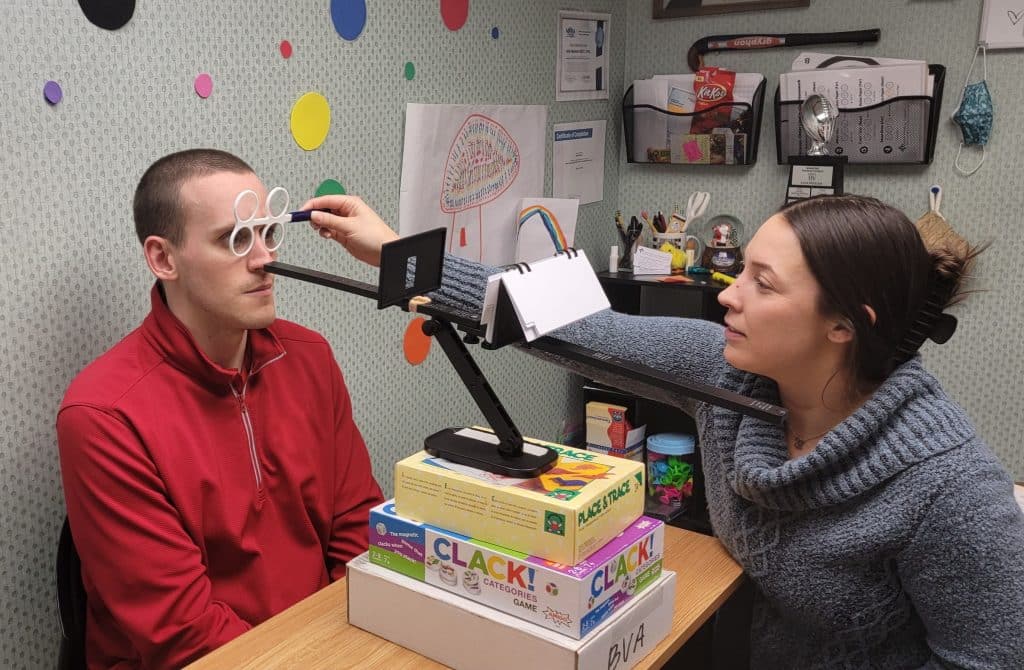
What is Vision Therapy?
Vision Therapy is a speciality service working under the direction of a Neuro-optometrist to re-educate the brain and eye connection by increasing your visual efficiency and visual perceptual skills. Most commonly prescribed post-concussion, vision therapy can help alleviate and/or resolve symptoms such as headaches, nausea, dizziness, blurry vision, double vision, eye strain, eye fatigue, difficulty scanning busy environments, difficulty reading and using a computer & more! In addition, Vision Therapy can be prescribed by your optometrist for developmental eye conditions in children interfering with their ability to participate in school and play effectively. Contact us today to get started.
- Convergence insufficiency
- Accommodative dysfunction
- Developmental eye conditions
- Concussion
- Saccadic dysfunction
- Pursuits dysfunction
- Eye coordination
What is visual efficiency?
Process of effectively viewing visual input. Visual efficiency encompasses visual tracking, eye-teaming and focusing.
Examples: skills required to read a book, transition from board to table or follow a moving object.
What is visual perception?
How we take in information and process it in order to make sense of it.
Examples: discriminating between right and left, an object in the foreground or background and visual memory.
Are you experiencing any of the below symptoms?
- Headaches?
- Blurry Vision?
- Double Vision?
- Difficulty staying on the line while reading/losing place?
- Words moving on the page while reading?
- Eye rubbing or squinting
- Fatigue from reading?
- Reduced attention to reading?
If you answered yes to any of the above, especially before, during or after reading, contact Priority Physical Therapy today to schedule an in-depth evaluation to determine your unique needs!
Resources:
Beck, C. (2022, December 8). Visual Efficiency and Vision Problems You Can Not “See.” The OT Toolbox.
Eye and Vision Conditions. (n.d.). American Optometric Association.
Vision Therapy FAQs
Vision therapy is a specialized treatment program designed to improve the connection between the brain and the eyes. Guided by a neuro-optometrist and delivered through physical therapy, it focuses on strengthening visual efficiency and visual perception. Many people seek vision therapy after a concussion, but it can also help with a wide range of vision-related challenges such as headaches, dizziness, blurry or double vision, eye strain, and difficulty reading or using screens.
Vision therapy is beneficial for both adults and children. It is commonly recommended for individuals recovering from a concussion, as well as those experiencing conditions like convergence insufficiency, accommodative dysfunction, saccadic or pursuits dysfunction, and eye coordination issues. Children with developmental eye conditions that affect learning, reading, or play can also see significant improvement through a personalized therapy plan.
If you frequently experience headaches, blurry or double vision, or eye fatigue—especially during reading or screen use—vision therapy may help. Other common signs include losing your place while reading, words appearing to move on the page, squinting or rubbing your eyes, and reduced attention or endurance when reading. These symptoms often point to underlying visual inefficiencies that can be improved with targeted therapy.

